Crying is Healthy and Faithful
Many people tend to fight the onset of tears, when crying is in fact a natural and beneficial response to several common emotions such as grief, sadness, dejection, and even joy. Tears are triggered by our emotions, but they are also a practical and protective reaction from the body. We produce three main types of tears.
Basal tears are in our eyes all day. Basal tears are functional, lubricating tears that help improve our vision, focus, and fight against infection. A protein called lysozyme is present in basal tears. This protein protects against viruses, bacteria, and fungi. Basal tears contain oil, mucus, salt, and water. The oil prevents the tears from evaporating and blinking spreads a layer of basal tears on the eye’s surface.
Reflex tears are our eyewash tears. These are triggered by environmental irritants such as dust, smoke, and wind. These tears flush out any irritating material for our eyes. These are also the tears produced when we cut an onion.
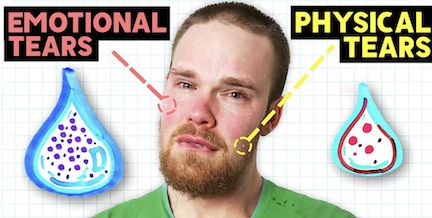
Emotional tears flood our eyes in response to strong emotions and are similar to basal tears in chemical makeup but also contain stress hormones and natural pain relievers.
Crying has a number of other proven benefits as well. Crying has a self-soothing effect which helps us to calm ourselves, regulate our emotions, and return us to a more neutral emotional state within a certain period of time. Deep belly breaths from crying and sobbing regulate our heart rate, blood pressure, and breathing - all of which aids in recovering from stress.
Crying can cause our body to produce hormones that make us feel better. We release oxycontin and endorphins after we cry, which can help reduce stress, relieve pain, and lift our mood. In other words, having a good cry can improve our mood after we cry.
Crying is also a way the body rids itself of chemicals that are released in the body to help us cope during times of stress, but can have negative impacts when not processed out of the body. So, if we try to push back the tears or feel shame when we cry, it can have the opposite effect, inducing anxiety, depression, upset stomach, and heart-associated issues.
Crying is also an attachment behavior. Crying signals to others that we need help and support. Most obviously associated with infants and small children, research suggests that crying serves the same functions in adults, facilitating deeper social connections and community support.
That means it is healthy and faithful to embrace what we feel, go through the valley with the Lord, cry the tears, and trust in the promise that we will be blessed on the other side of what brings the tears.
"You have kept count of my tossings; put my tears in your bottle. Are they not in your book?" (Psalm 56:8, ESV).
"Those who sow in tears shall reap with shouts of joy!" (Psalm 126:5, ESV).
"A time to weep, and a time to laugh; a time to mourn, and a time to dance" (Ecclesiastes 3:4, ESV).
"For godly grief produces a repentance that leads to salvation without regret, whereas worldly grief produces death" (2 Corinthians, 7:2, ESV).
"For you have delivered my soul from death, my eyes from tears, my feet from stumbling" (Psalm 116:8, ESV).
Life Lessons From Cockroaches
Cockroaches are fascinating creatures. Did you know that they can continue living days, even weeks, after being decapitated. That’s because their blood pressure, circulation, and respiration is not controlled by their brains. They can feel and sense and amble about, appearing whole, though headless. And what’s even creepier is that their heads will survive also. Yet neither will survive effectively.
The body will roam around aimlessly, with no memory or mission, until it finally starves to death (seems they do at least need the head to eat). The head will also survive, with antennae strobing, responding to stimuli, consciously aware of its surroundings, but unable to move or make any impact on its environment. Two separated parts of one body – alive, yet utterly ineffectual. Check out this video.

So often, we Christians are like decapitated cockroaches. Some of us walk around all all caught up in our feelings. We care deeply about people or issues. We even interpret Scripture or make assessments of God’s will based on our “feelings” about a given issue, circumstance, or situation.
Others of us walk around like a head without a heart. We have tons of knowledge, but lack grace, compassion, or empathy. In short, we lack God’s agape love. We spout knowledge as if knowledge alone can have effectual impact.
The Christian must think, respond, react with their entire being. Feelings without thoughtfulness, knowledge, wisdom, can leave us reactionary, grounded in our own senses, rather than in the truth and mind of God. Knowledge without feelings – or better said, heart, compassion, empathy, agape love – simply puffs up.
Like the cockroach, our hearts and minds must be in touch with each other, working in a symbiotic relationship if we are to minister the “whole” counsel of God.
“… Knowledge puffs up, but love edifies.” 1 Cor 8:1 (NKJV)
“If I speak in the tongues[a] of men or of angels, but do not have love, I am only a resounding gong or a clanging cymbal. If I have the gift of prophecy and can fathom all mysteries and all knowledge, and if I have a faith that can move mountains, but do not have love, I am nothing. If I give all I possess to the poor and give over my body to hardship that I may boast, but do not have love, I gain nothing.” 1 Cor 13:1-3 (NIV)
“Trust in the LORD with all your heart, and do not lean on your own understanding [e.g., feelings or emotions]. In all your ways acknowledge him, and he will make straight your paths.” Prov 3:5-6
The Topography of Tears
Ever wondered what your tears really look like? Rose-Lynn Fisher did. "One day I wondered if my tears of grief would look any different from my tears of happiness - and I set out to explore them up close."
"The Topography of Tears" she says, "is a study of 100 tears photographed through a standard light microscope. The project began in a period of personal change, loss, and copious tears. … Years later, this series comprises a wide range of my own and others’ tears, from elation to onions, as well as sorrow, frustration, rejection, resolution, laughing, yawning, birth and rebirth, and many more, each a tiny history."?
In photographing these various tears, she discovered that they are not unlike snowflakes--each one unique in its composition and design. Tears of joy looked nothing like tears of sorrow. And tears of elation looked nothing like the tears we shed when chopping an onion.
They can be explained, in part, by the chemistry of our tears:
Joseph Stromberg of the Smithsonian’s Collage of Arts and Sciences explained that there are three major types of tears: basal, reflex, and psychic (triggered by emotions). All tears contain organic substances including oils, antibodies, and enzymes and are suspended in salt water. Different types of tears have distinct molecules. Emotional tears have protein-based hormones including the neurotransmitter leucine enkephalin, which is a natural painkiller that is released when we are stressed. Plus, the tears seen under the microscope are crystallized salt and can lead to different shapes and forms. So even psychic tears with the same chemical composition can look very different.
"The random compositions I find in magnified tears often evoke a sense of place," says Fisher, "like aerial views of emotional terrain."*
Although the empirical nature of tears is a chemistry of water, proteins, minerals, hormones, antibodies and enzymes, the topography of tears is a momentary landscape, transient as the fingerprint of someone in a dream. This series is like an ephemeral atlas ….
Tears are the medium of our most primal language in moments as unrelenting as death, as basic as hunger, and as complex as a rite of passage. They are the evidence of our inner life overflowing its boundaries, spilling over into consciousness. Wordless and spontaneous, they release us to the possibility of realignment, reunion, catharsis: shedding tears, shedding old skin. It’s as though each one of our tears carries a microcosm of the collective human experience, like one drop of an ocean.
*Follow the link to source above to view their "topography" to understand just how personal tears are and how unique they are to our life experience.
It seems our tears are indeed an atlas of our life experience--the hills and valleys, the quiet streams and the raging oceans. As varied and sundry as our tears may be, it is so comforting to know that God tracks every one of them. He sees them. He knows them. He feels them. Whether in joy or sorrow, we are never alone in our tears.
"You keep track of all my sorrows. You have collected all my tears in your bottle. You have recorded each one in your book" (Psalm 56:8, NLT).
"For the Lamb in the midst of the throne will be their shepherd, and he will guide them to springs of living water, and God will wipe away every tear from their eyes" (Revelation 7:17, ESV).