The Process Of Inspiration
Concerning the verbal inspiration of the Bible, Paul Enns writes:
Peter . . . acknowledges his belief in verbal inspiration inasmuch as it was the Holy Spirit who guided the writers of Scripture in their selection of words. This truth could be illustrated by a man who goes to the department store in a shopping center. Because he is in a hurry to get to the second floor he walks up the escalator. Although he is walking, the escalator is carrying him along, bringing him to the second floor.
Mr. Enns concludes:
Similarly, although the writers of Scripture penned the words according to their educational abilities and their own distinctive styles, the Holy Spirit was carrying them along, ensuring the accuracy of all they were writing.
"All Scripture is given by inspiration of God, and is profitable for doctrine, for reproof, for correction, for instruction in righteousness, that the man of God may be complete, thoroughly equipped for every good work" (2 Timothy 3:16-17, NKJV).
"And so we have the prophetic word confirmed, which you do well to heed as a light that shines in a dark place, until the day dawns and the morning star rises in your hearts; knowing this first, that no prophecy of Scripture is of any private interpretation, for prophecy never came by the will of man, but holy men of God spoke as they were moved by the Holy Spirit" (2 Peter 1:19-21, NKJV).
When Sermon Illustrations Go Horribly Wrong
Everybody loves a great sermon illustration. I mean, that's why you're on this site right now, isn't it? A great illustration has the ability to drive home a point, make a lasting impression, and provide visual imagery that will linger in the minds of congregants long after the sermon is over.
But what happens when a sermon illustration goes terribly wrong — driving home the point, all right, just the wrong point driven in just the wrong place.
Well that's what happened to Pastor Scott Thomas of Free Life Chapel in Lakeland, Florida.
Cindy and I spoke on “Building A Marriage” and used a wedding cake for our illustration. To close the teaching, we stressed that if we build our marriages outside of God’s order… the whole cake (marriage) crashed!
All went well… until I slammed the cake upside down and SURPRISINGLY DISCOVERED that the cake company had implanted a dowel inside to hold the cake layers together.
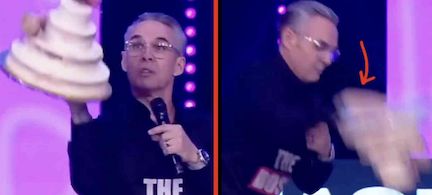
When I slammed the cake upside-down the dowel pierced through the bottom of the cake and traveled completely through my hand! When I looked down… the dowel was sticking 5 inches out the back of my hand! I immediately pulled the stick out of my hand and tried to wrap my head around what just happened!
Cindy immediately slid me a towel… I wrapped my hand, finished the message and prayed to close out the session in the next 5 minutes.
Fortunately, Pastor Thomas is fine, with no lasting injury. And he and his wife were both able to laugh it off in the end. Yet it's an illustration that won't soon be forgotten.
Click here for video (ouch!).
As pastors and teachers we are all called to, "Do [our] best to present [ourselves] to God as one approved, a worker who does not need to be ashamed and who correctly handles the word of truth" (2 Timothy 2:15, NIV).
To that end, we often employ sermon illustration to "drive home" our "point," even as Pastor Thomas so literally (albeit painfully) did. The right illustration can make just the right point at just the right time.
They won't all land quite the way we intended. They won't all be as memorable as we'd hoped. They certainly and hopefully won't be as painful as poor Pastor Thomas' was!
But a great bible teacher is always looking for ways to more dynamically communicate the truths of God's Word. To this end, if you've landed on this site, we applaud you! And we are blessed beyond measure to partner with you to that end!
Your Illustration Exchange Team
Keeping Our Eyes on the Banner of Freedom
When the Americans first occupied Manila, many prisoners that had been imprisoned for "political offenses" were set free. One of these crimes, according to the Spanish government, which then ruled the Philippines, was reading the Bible. One day a man came to famed Christian missionary Dr. Homer Stuntz, and asked to see him in strict privacy. He then asked in a whisper if it were true that he could now read his Bible without danger of imprisonment. Dr. Stuntz took him to the door and asked him to look at the American flag floating near by. Then he said, "So long as you see that flag floating over your country, you can sit on the ridgepole of your house, if you want to, and read the Bible, and no one can molest you."
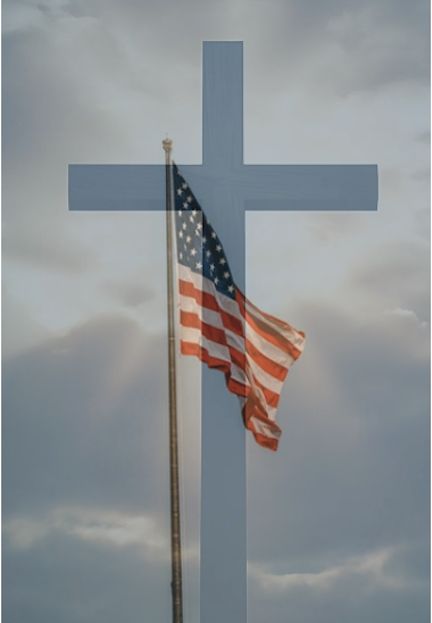
Surely the American flag -- the banner of our freedom -- can offer one measure of assurance. Yet there is an infinitely (and eternally) greater banner under which we can claim not just our freedom, but our boldness to excercise such freedom, and that is the Cross of Christ. It is the symbol of our freedom from the bondage of the world, the flesh, and the devil. And it is likewise the symbol of our calling to boldly persist against pressure, persecution, and even penalty.
"It is for freedom that Christ has set us free. Stand firm, then, and do not let yourselves be burdened again by a yoke of slavery" (Galatians 5:1, NIV).
"So if the Son sets you free, you will be free indeed" (John 8:36, NIV).